
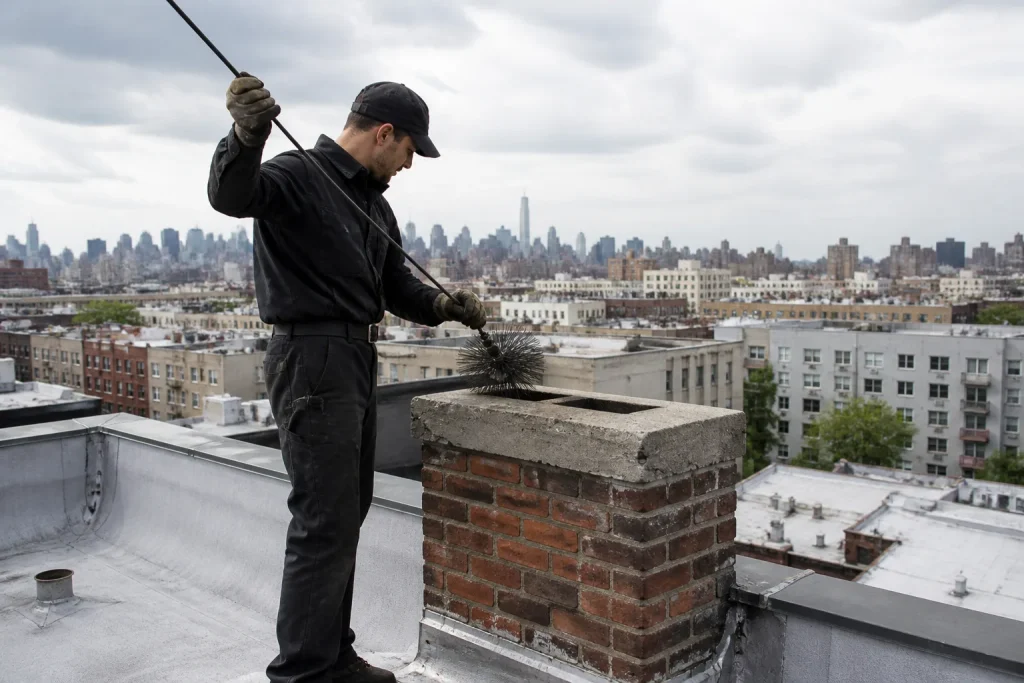
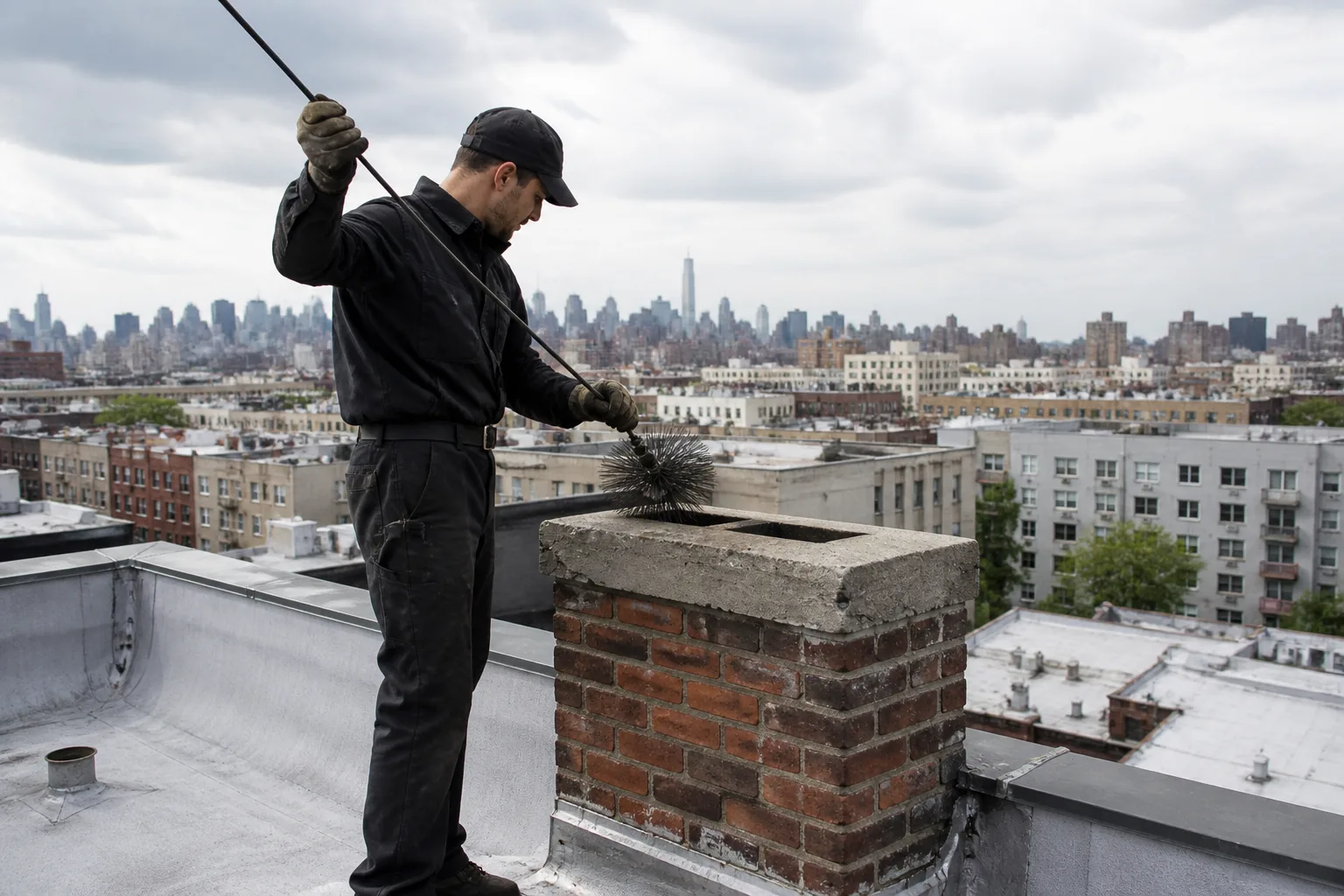
Chimney Sweep: Repair or Replace? How Bushwick Homeowners Decide
Repair or replace comes down to three things a qualified sweep can actually measure: how much of the liner is still intact, what condition the crown and cap are in, and whether the firebox refractory is holding. If a technician recommends a full rebuild after a visual look alone, with no video scan of the flue, that’s a guess dressed up as a diagnosis. The difference between a few thousand dollars of targeted repair and a full rebuild often sits in those measurements, and they can be documented before anyone touches a masonry saw.
What should a Level 2 video scan show before you decide?
A Level 2 inspection is the only basis for a repair-or-replace call, because it’s the only one that lets a technician see the full interior of the flue from top to bottom. A camera on a rod travels the length of the liner and records what it finds: cracks, spalling, gaps at the joints, offset flues, and any place where creosote has baked into a damaged surface. In our experience, the recordings settle most arguments before they start.
Ask exactly what the scan covers, and expect documentation for each item:
- Liner integrity. Not a pass/fail, but a percentage of the flue that’s sound. Small isolated defects in an otherwise solid clay liner can be repaired. Widespread cracking, or a liner that’s separated at the joints, points toward relining or replacement.
- Crown and cap condition. A cracked crown lets water in, and water is the leading cause of long-term chimney deterioration. A missing or rusted cap does the same from the top. Both are repairable, and both are worth fixing regardless of what happens with the liner.
- Firebox refractory status. The firebox takes the most heat of any part of the system. Cracked refractory brick or a deteriorated firebox floor can usually be rebuilt without touching the flue above it.
If any of those three are missing from the report, you don’t have a diagnosis yet. You have an estimate.
Is partial relining the middle path, or a stopgap?
Partial relining is often the correct answer, and it’s the option most homeowners never hear about. When the structural clay liner is mostly sound but the interior surface is spalled, pitted, or has gaps at the joints, a resurfacing system can restore the flue’s integrity from the inside, without demolition and without pulling the whole chimney apart. HeatShield is the system we use for this, and it’s the reason a deteriorating flue doesn’t automatically mean a rebuild.
For flues that need a new liner outright, a stainless flexible liner is the standard solution. DuraFlex liner systems install down an existing flue with minimal disruption to the masonry, which matters in a rowhouse where the chimney shares a wall with the neighbors. The liner goes in, the appliance reconnects, and the chimney keeps its original footprint.
Partial relining is not the right call in a few cases, and an honest sweep will say so:
- The clay liner is cracked through the wall thickness, not just at the surface.
- The flue has separated joints or a significant offset that a liner can’t negotiate safely.
- The chimney has lost structural integrity in the masonry itself, above and beyond the flue.
When any of those apply, resurfacing just hides the problem. The right move is a full liner or a rebuild.
How does Bushwick rowhouse construction change the equation?
Bushwick’s rowhouse stock makes the replace decision harder than it is in a detached house, and it changes what “replacement” even means. Shared party walls mean a chimney isn’t always yours alone to knock down and rebuild. Corbeled flues – the flues that step outward as they rise – are common in older buildings, and they can’t simply be pulled and replaced like a straight stack. And if the building sits in a landmark district, exterior masonry work may require approvals before a single brick comes out.
What that means in practice:
- A rebuild that would be routine on a detached house may be a coordination job in a Bushwick rowhouse, involving a neighbor, a co-op board, or the landmarks process.
- Minimally invasive solutions get more valuable, not less. A liner that installs down the existing flue avoids exterior work entirely.
- Crown and cap work stays local to the top of the stack and rarely runs into the same restrictions, which is why we treat chimney cap & crown as its own specialty – it’s the highest-leverage moisture defense you can put on a Bushwick chimney without touching the walls.
A sweep who works in this neighborhood should be able to tell you which of these applies to your building before quoting a rebuild.
How do you compare a repair against a replacement over time?
Compare a repair and a rebuild on cost horizon, not on sticker price. Take a targeted repair with a realistic ten-year outlook and set it against a full rebuild with a thirty-year outlook, and the math changes depending on how long you plan to hold the property.
A rough framework to run your own numbers:
- Short hold, sound structure. If you’re selling or moving within a few years and the liner is mostly intact, a documented repair usually makes more sense than a rebuild.
- Long hold, marginal liner. If you plan to stay and the liner is at the point where it’ll need relining anyway, a full liner now with the crown and cap handled at the same time is the better money.
- Structural masonry damage. If the chimney itself is compromised, cost horizon doesn’t rescue the repair. Fix the structure.
Ask for both numbers in writing, each with what it covers, and compare them that way. A repair that buys ten years isn’t a bargain if you’re relining next decade regardless. A rebuild isn’t a bargain if the existing flue had years of safe service left.
What documentation do you need for a board, landlord, or insurer?
If you’re making the case to a co-op board, a landlord, or an insurance carrier, the argument is won or lost on paperwork. A capital repair versus a full replacement is a decision someone else has to approve, and they’ll approve the option you can prove.
Ask your sweep for a package that includes:
- The Level 2 inspection report, with the video scan included or linked.
- Photos of the crown, cap, firebox, and any interior liner defects.
- A written diagnosis that names the specific conditions found, not just “chimney needs work.”
- Two line-item estimates side by side – repair and replacement – each with a stated scope.
That package is what turns “the chimney guy says it needs replacing” into a capital request a board can actually evaluate. It’s also the honest standard we hold ourselves to: we diagnose before we recommend, inspection first, always.
When to call a pro
Call a professional if you can’t remember the last time the chimney was swept, if you smell creosote in the house, if smoke backs into the room when you burn, or if the crown or cap looks damaged from the ground. And call before you authorize any major work based on a visual inspection alone. A chimney sweep in Bushwick should be able to show you the video and explain what it means before recommending a rebuild. A proper chimney repair starts with evidence, and a proper Chimney Sweep Bushwick visit starts with a real inspection, not a sales pitch. If you want a licensed, insured professional to look at it properly, our technicians have up to 10 years of experience, and they’ll tell you plainly when work can safely wait.
Related services in Bushwick
If the diagnosis points to routine cleaning, our chimney sweep service covers the annual sweep and inspection. If it points to the crown or cap, that’s a moisture-defense job we handle as its own specialty.
The Bottom Line
Repair or replace on a Bushwick chimney isn’t a coin flip. Measure the liner, the crown and cap, and the firebox refractory first, and let the video scan decide. Partial relining with HeatShield or a DuraFlex liner often lands between spot repair and full rebuild, and in a rowhouse it’s frequently the smartest option because it avoids exterior masonry work and landmark complications. Compare the numbers on cost horizon, not sticker price, and get both estimates in writing with a scope attached.
Our brand portfolio lets us handle cap, crown, liner, flue, and firebox work with professional-grade materials from HeatShield, DuraFlex, Gelco, Olympia Chimney, Famco, and Copperfield – not off-the-shelf substitutes.
If you’re in Bushwick and need help deciding, Chimney Sweep Bushwick offers free estimates. Call (855) 337-1157. We answer 24/7, with fast dispatch from 7am to 7pm, Sunday through Friday.
Frequently Asked Questions
That depends on the condition the video scan shows, not on the age of the chimney. Surface spalling and joint gaps in an otherwise sound clay liner can often be restored with HeatShield resurfacing. Cracking through the wall thickness, separated joints, or a compromised offset usually means a full liner. Call (855) 337-1157 for a free estimate.
A sweep recommending a rebuild without a Level 2 video scan isn’t giving you a diagnosis. Ask for the scan, the photos, and a written report that names the specific conditions. If the recommendation survives all three, it’s likely real; if not, get a second opinion. Call (855) 337-1157 for an honest inspection.
A partial reline is not a patch – it’s a restored flue surface that serves the life of the liner, when the structural clay behind it is sound. It’s only a stopgap when the underlying liner is already cracked through or separated, which is why the video scan matters. Call (855) 337-1157 for an estimate.
Yes. Ask for two line-item estimates, one for repair and one for replacement, each with a stated scope. Compare them on cost horizon and on how long you plan to hold the property, not on the bottom line alone. Call (855) 337-1157 for a free estimate.
Written by the team at Chimney Sweep Bushwick.
Need Chimney Cleaning Help?
Call Chimney Sweep Bushwick - the local pro we connect you with is licensed and insured, with free written estimates in Bushwick.
(855) 337-1157